The desert during Ramadan: the well-informed traveller's guide
By the Desert Foum Zguid team · Updated 14 August 2026
Short answer: Ramadan is an excellent time for the desert — tours run normally, your meals are guaranteed, and you get one of Morocco's most singular atmospheres on top. In 2027 the holy month will fall approximately from 8 February to 9 March (subject to the lunar sighting): right in the dunes' high season. Here is what actually changes, and what belongs to myth.
What does not change (the essentials)
Departures, routes, camps, prices: everything runs identically. Tourist Morocco does not stop for Ramadan, and the South even less — February-March is the heart of our season. Your travellers' meals are served normally from breakfast to dinner, water stays unlimited on board, and nobody will ask you to fast or take offence that you don't.
What changes (and is worth the trip)
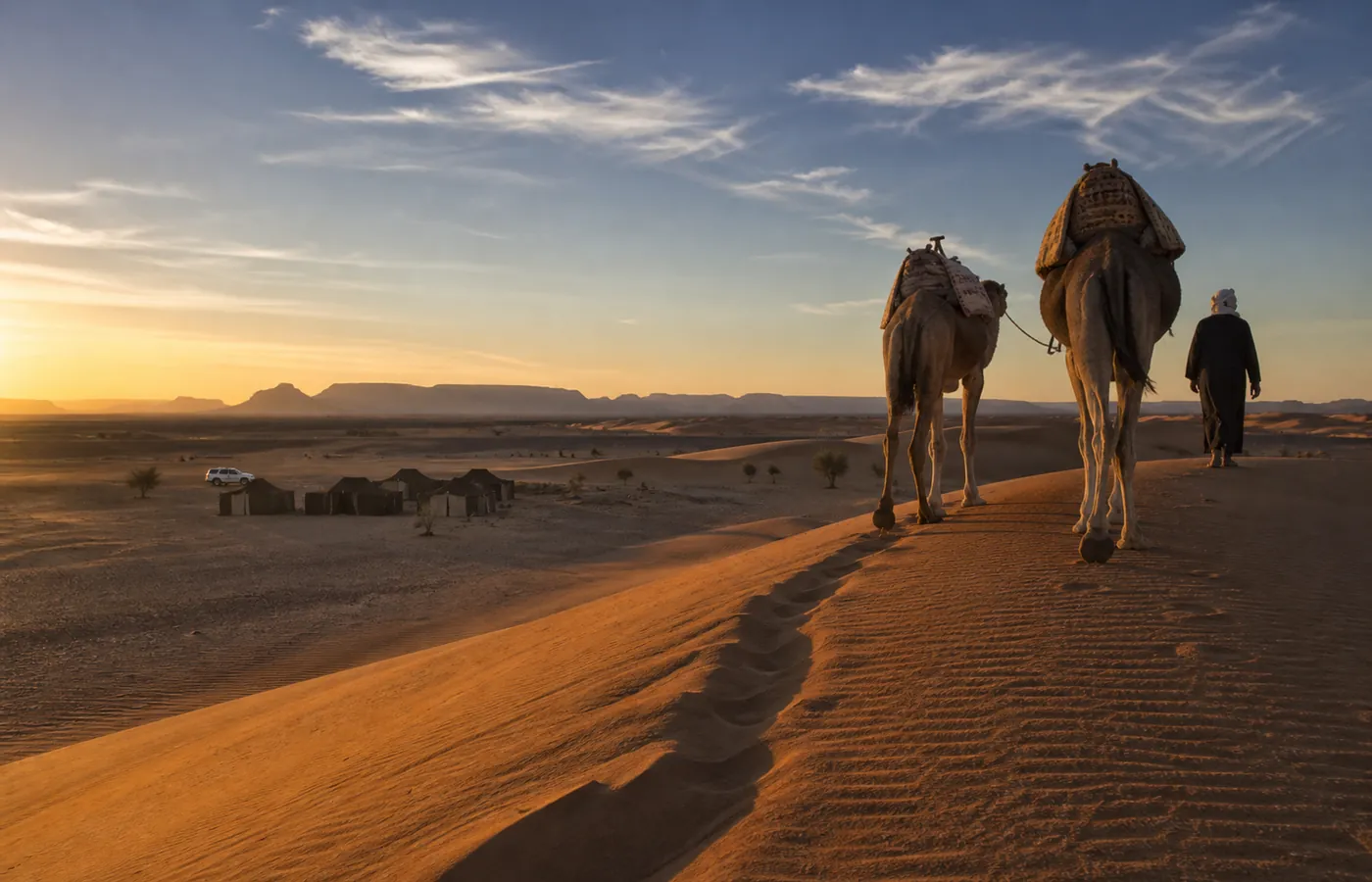
The country's rhythm shifts to the evening, and the desert makes it spectacular. The ftour — breaking the fast at sunset — becomes a suspended moment at the camp: steaming harira at the exact hour the sun touches the dunes, dates passed from hand to hand, then an evening that stretches later and merrier than usual. Being invited to share that moment with the crew is frequent and sincere. Many of our Ramadan travellers leave saying they saw "the real Morocco" — a big phrase, but the experience does have a depth the standard high season does not offer.
The three honest practical adjustments
- First-day timings. In the departure cities (Marrakech, Ouarzazate), expect cafés closed during the day and jittery traffic just before sunset — our pick-up times anticipate it.
- Basic courtesy. Eating in the 4x4 or at the camp: no problem at all. Picnicking ostentatiously in the middle of the souk at 4 p.m.: avoidable. Guest common sense, not a rulebook.
- The end of the month. Eid al-Fitr (1-2 days of celebration closing Ramadan) is the equivalent of a family Christmas: our teams run on reduced numbers and some dates close. If your trip lands on Eid, write to us early — we organise around it, not against it.
The calendar for the coming years
Ramadan moves forward about eleven days each year: approximately 8 February to 9 March in 2027, then late January-February in 2028 — which means, for several years yet, right inside the desert's best season (the month-by-month climate detail is in our guide to the best time to visit the Sahara). Exact dates depend on the lunar sighting and firm up only a few days ahead: if your trip borders the start or end of the holy month, check with us when booking.
Frequently asked questions
Do the tours run normally during Ramadan?
Yes, fully: same departures, same routes, same prices. Our teams fast and work — as everywhere in Morocco — and the organisation adapts internally (driver relays, break-fast meals carried along). You, the travellers, eat and drink normally: the unlimited water in the 4x4 does not change.
Is it rude to eat in front of guides who are fasting?
No — and they are the ones who say so. The fast is a personal commitment, not a rule imposed on guests; your discomfort would be more awkward than your lunch. Basic tact is enough: avoid feasting under someone's nose at 5 p.m., offer to share your tea at ftour if the moment lends itself. An invitation to break the fast together, if it comes, is an honour one does not decline.
Are restaurants open during the day in Foum Zguid?
A few addresses serve travellers during the day, discreetly, and the groceries stay open. On our tours the question does not arise: meals are planned and served normally. In the evening, though, the village comes alive with a particular energy after ftour — one of the finest atmospheres of the year.