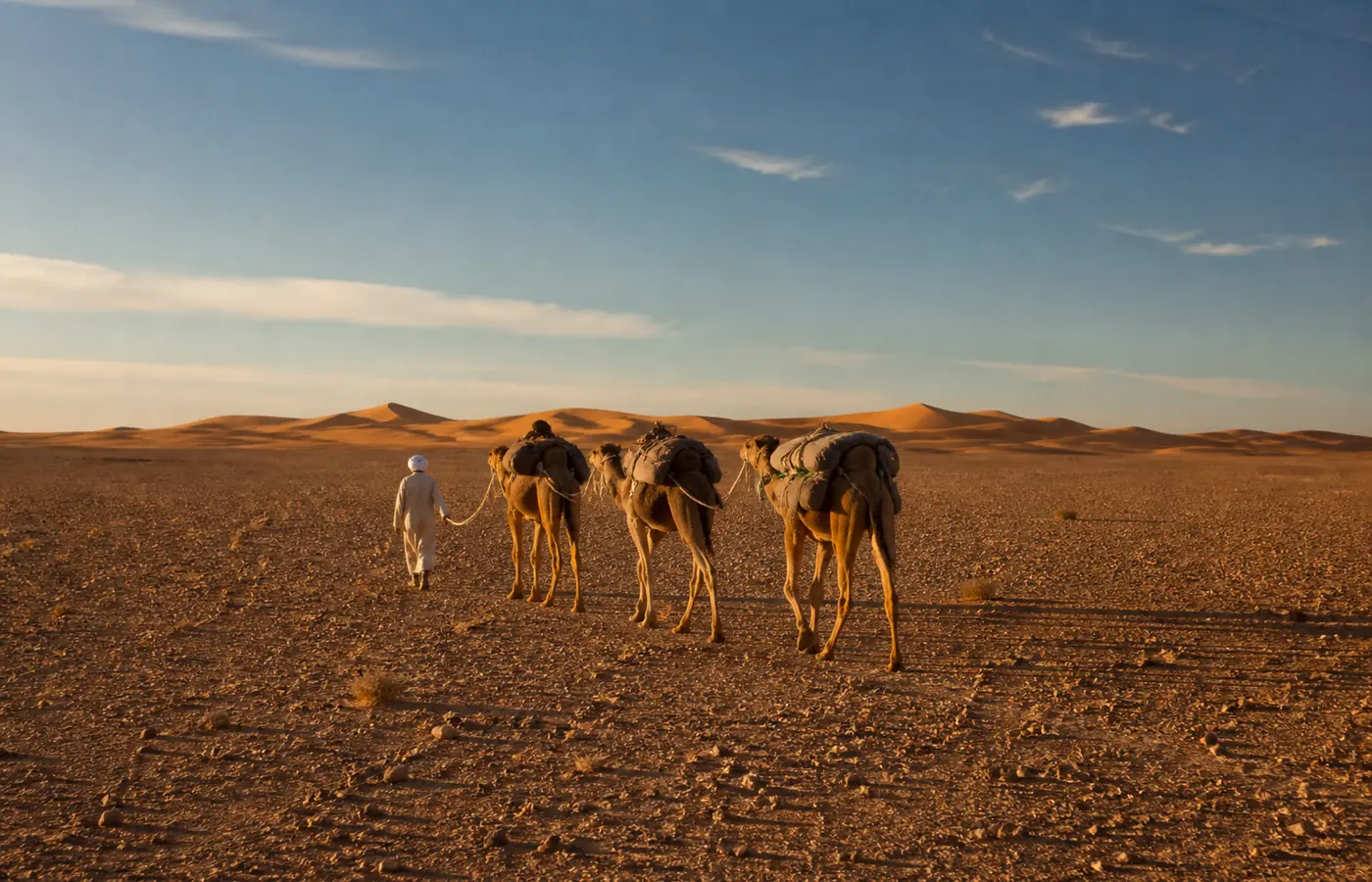
The desert at camel pace is four kilometres an hour. At that speed you stop crossing the landscape and start watching it change. Tracks on the ground become readable, acacia trees become countable, and the silence is never broken by an engine. This is how people travelled here for centuries, and it is still the finest way.
This three-day trek leaves the Foum Zguid palm grove on foot, follows Jbel Bani, then reaches the dunes of Erg El Mhazil and the northern edge of Lake Iriqui. You walk with the caravan, ride a camel whenever you feel like it, and the camp travels with you: a new dune every night, a new fire, and nobody else on the horizon.
You travel with a cameleer from the region, whose animals have belonged to the family for generations, and a cook who raises the camp while you watch the sun go down.
Highlights
- Three days walking with a camel caravan
- Erg El Mhazil dunes and the edge of Lake Iriqui
- Mobile camp: a different campsite every night
- Cameleer and cook from Foum Zguid
- No vehicles on the route, no engine noise
- Your pace: walk or ride, as you please
Itinerary
- Day 1
Foum Zguid → foot of Jbel Bani
Departure from the palm grove late morning, once the camels are loaded. Four hours walking south, lunch in the shade of an acacia, then a gentle climb to the first camp at the foot of the black mountain. Sunset on the ridges, dinner by the fire.
- Day 2
Into the Erg El Mhazil dunes
The finest day: you leave the stony ground for sand, and the erg arrives in waves. Five to six hours of walking broken by stops, with a long siesta through the hot hours. Camp in the heart of the dunes, and a climb to a crest for the starry night.
- Day 3
Edge of Lake Iriqui, return
Up before the sun to walk in the cool as far as the edge of Lake Iriqui, where sand gives way to white clay. Lunch, then a 2 h drive back to Foum Zguid so you need not retrace the whole route on foot.
What's included
✓ Included
- Camels (one per person) and cameleer
- Cook and full mobile camp
- Full board from day-1 lunch to day-3 lunch
- Tents, mattresses, blankets and sleeping bags
- 4x4 return from Lake Iriqui
- Plenty of water and tea
✕ Not included
- Other drinks
- Personal sleeping bag if you prefer your own
- Tips
Walk or ride: your choice
Most people picture a camel trek as three days in the saddle. In practice you alternate: the caravan moves at walking speed, and it is more comfortable to walk alongside for much of the time, climbing on for the long straight stretches, the end of the day, or whenever your legs ask for it. Nothing is compulsory either way, and nobody counts the kilometres.
Even so, expect four to six hours of progress a day on flat or gently sloping ground. No technical difficulty, but a real tiredness in the evening, the kind that makes you sleep well.
The mobile camp, not a fixed one
The difference from a night at an established camp is sharp. Here everything rides on the camels: light tents, carpets, mattresses, cooking pots. Camp goes up wherever the day ends, often in the lee of a dune the cameleer picks for shelter from the wind. There is no shower, no lighting, no neighbours. A basin of hot water in the evening, a paraffin lamp, the fire, and nothing else.
It is rougher than our Erg Chegaga camp, and that is exactly the point: you sleep somewhere nobody slept last night and nobody will sleep tomorrow.
Season and climate
The trek runs October to April. Outside that window walking becomes too demanding: above 35 °C even the cameleers refuse to set out, and they are right. The best months are November and March, when days hold around 24 °C and nights stay comfortable under canvas.
Frequently asked questions
Can you reach Erg Chegaga by camel?
Yes, but not in three days: allow 5 to 6 days of walking from Foum Zguid, one way, with a 4x4 return. We arrange that crossing on request for groups with the time. The 3-day trek described here goes as far as Erg El Mhazil, closer in, whose dunes are more modest but whose solitude is complete.
Do I need walking or riding experience?
Neither. We show you how to mount and dismount on the first day and the rest follows naturally. As for walking, if you can manage a three-hour hike on flat ground, this trek will not trouble you.
What about washing?
A basin of hot water is prepared every evening, screened behind the tents. For the rest, the desert rule applies: walk away, dig, fill in, and carry the paper out. Your cameleer explains all of this without embarrassment on day one.
Is the trek suitable for families?
From about age 8, yes, and it makes a formidable childhood memory. We adapt the stages for family groups: shorter days, more stops, and one camel for two light children if needed.
What goes in the bag?
One soft bag of 8 to 10 kg maximum, carried by the camels: scarf, sunglasses, sunscreen, light walking shoes, sandals for the sand, fleece, warm hat in winter, head torch and a water bottle. The rest of your luggage stays in storage with us in Foum Zguid.
More questions? See our full FAQ and our traveller reviews.